
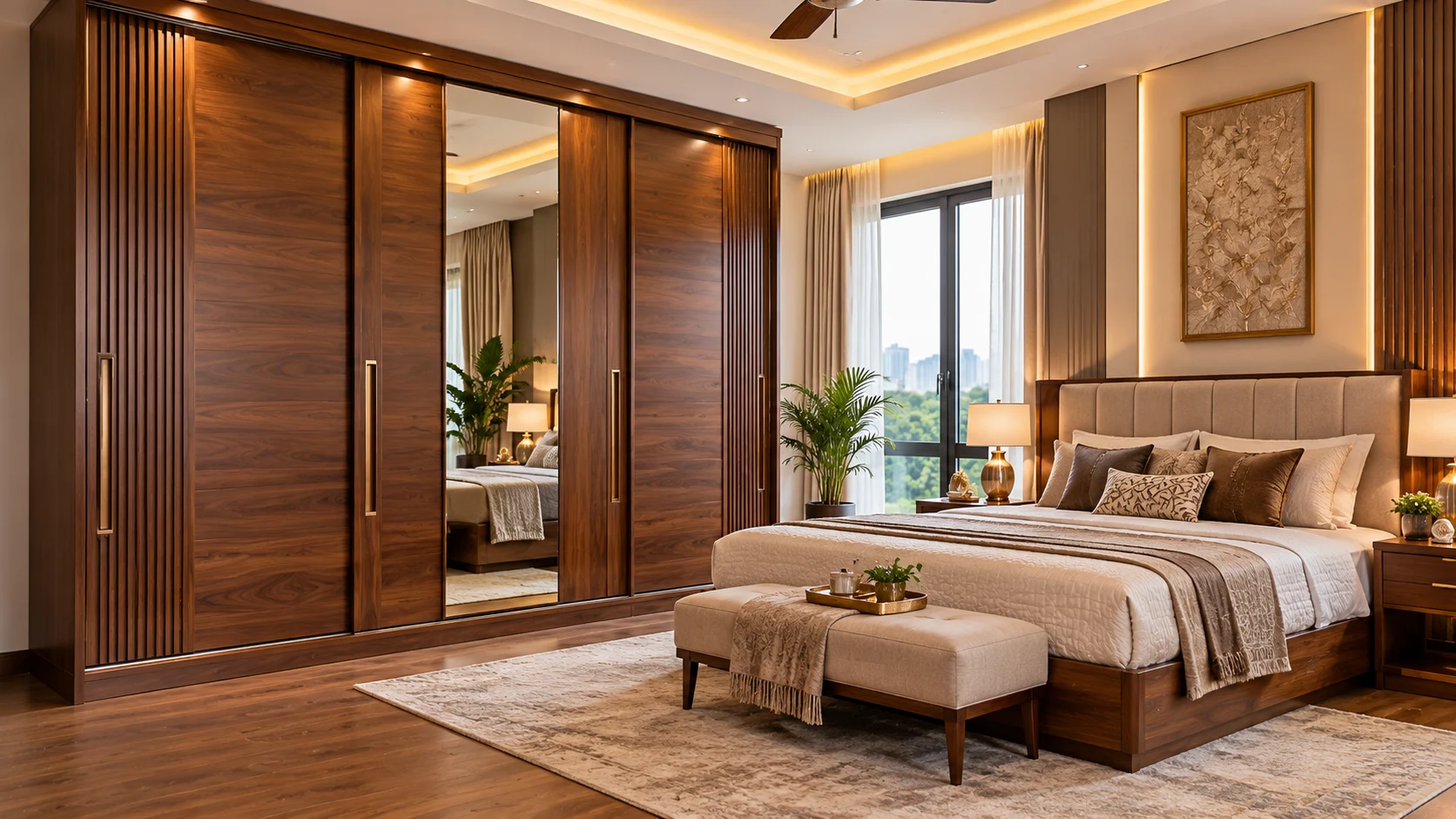
Choosing the right wardrobe Saharanpur homeowners can use in their bedrooms involves more than selecting an attractive colour or door design. A wardrobe should provide sufficient storage, fit the available space, offer convenient access to clothing, and complement the overall bedroom interior.
Two popular wardrobe configurations are sliding-door wardrobes and hinged-door wardrobes. Both can provide practical storage, but their door mechanisms, space requirements, appearance, and everyday usability are different.
A sliding wardrobe uses doors that move horizontally along tracks. This arrangement avoids the outward door swing required by a hinged wardrobe. Hinged wardrobes use doors attached to the frame with hinges and can provide access to the full wardrobe interior when opened.
The right option depends on your bedroom layout, available clearance, storage requirements, and budget.
Fatima Handicraft’s official wardrobe collection presents several wardrobe categories, including sliding-door wardrobes, hinged-door wardrobes, walk-in wardrobes, wooden wardrobes, and mirror wardrobes. The website also describes customisable sizes, finishes, colours, and layouts.
FATIMA HANDICRAFT
This guide explains the differences between sliding and hinged wardrobes, popular designs, internal storage arrangements, materials, pricing considerations, and practical buying tips to help you select a suitable wardrobe for your home.
1. Why Choosing the Right Wardrobe Design Matters
A wardrobe is one of the most important pieces of bedroom furniture because it determines how clothing, accessories, and other personal belongings are organised.
An unsuitable wardrobe can make a bedroom feel crowded, restrict movement, or provide insufficient storage. A well-planned wardrobe can use available wall space efficiently and help maintain an organised room.
Storage and organisation
Think about everything you intend to store before choosing a wardrobe.
Your requirements may include:
- Everyday clothing.
- Formal outfits and dresses.
- Shirts and trousers.
- Sarees and traditional clothing.
- Shoes and accessories.
- Handbags and travel bags.
- Bedsheets and additional bedding.
- Seasonal clothing.
The internal arrangement should reflect your actual storage habits rather than simply providing the largest possible number of shelves.
Bedroom space utilisation
Wardrobe doors affect how the surrounding bedroom can be arranged.
A hinged wardrobe needs space in front for the doors to open. A sliding wardrobe avoids this outward movement but requires a track system and provides access to only part of the interior at a time.
Before selecting a design, measure the distance between the wardrobe wall and nearby furniture, particularly the bed.
Interior appearance
Wardrobes occupy a substantial amount of visible wall space. Their colour, material, finish, handles, and door design can influence the entire bedroom.
Traditional wooden finishes can complement classic Indian interiors, while minimalist panels and mirrors can suit contemporary bedrooms.
Choosing a coordinated wardrobe can help create a more balanced bedroom alongside your bed, bedside tables, and other furniture.
For overall bedroom planning, you can also explore Fatima Handicraft’s premium bed collection.
2. What Is a Sliding Door Wardrobe?
Modern Floor-To-Ceiling 5-Door Sliding Door Wardrobe Design With Mirror
A sliding wardrobe features doors that move horizontally along a track system rather than opening outward into the room.
Depending on the design, two or more panels may overlap while moving across the wardrobe.
This configuration is particularly useful when there is limited clearance between the wardrobe and the bed or another piece of furniture.
Main features of sliding wardrobes
Sliding wardrobes commonly include:
- Two or more horizontally moving panels.
- Upper and lower sliding tracks.
- Wooden, laminate, mirror, or other decorative door finishes.
- Internal hanging rails and shelves.
- Optional drawers and organisers.
- Different panel arrangements depending on wardrobe width.
The design can create a clean appearance because large panels cover the storage area without requiring outward-opening handles or doors.
Advantages of sliding wardrobes
Space-saving door operation: Sliding doors do not require the same outward swing space as hinged doors. This can help in bedrooms where the bed is positioned close to the wardrobe.
Contemporary appearance: Large sliding panels can create a smooth, uncluttered appearance that complements modern bedroom interiors.
Mirror integration: Some designs incorporate full-length mirrors into their doors, which can reduce the need for a separate dressing mirror.
Suitable for wider wardrobes: Sliding configurations can work well across wider wardrobe sections where conventional doors might create several individual openings.
Flexible finishing: Different colours, textures, wooden finishes, and mirror panels can be considered depending on the selected system.
Disadvantages of sliding wardrobes
Sliding wardrobes also have limitations that should be considered.
Partial interior access: Because the panels overlap, only part of the wardrobe can be accessed at a time.
Track maintenance: Dust and debris can collect in the tracks, so periodic cleaning is important.
Hardware requirements: The quality and alignment of rollers and tracks influence how smoothly the doors operate.
Internal accessibility: Drawers or shelves may need to be planned carefully so they do not conflict with the overlapping door panels.
Additional installation considerations: Sliding systems require suitable track placement and alignment, which should be considered during installation.
Who should choose a sliding wardrobe?
A sliding wardrobe may be appropriate when:
- Your bedroom has limited floor clearance.
- The bed is positioned close to the wardrobe.
- You prefer large, uninterrupted door panels.
- You want an integrated mirror.
- You are planning a contemporary bedroom interior.
- You have a wider wall available for wardrobe installation.
The final choice should depend on the measured room layout and the specific sliding system.
3. What Is a Hinged Door Wardrobe?
Woodwork Wardrobe Guide | Custom Wooden Wardrobes & Storage Solutions – GoldenHome Global
A hinged wardrobe uses doors attached to its frame through hinges. These doors swing outward when opened, exposing the wardrobe’s internal compartments.
It is a familiar wardrobe configuration found in many traditional and contemporary bedrooms.
Unlike sliding wardrobes, hinged designs can provide access to the complete interior when all doors are opened.
Main features of hinged wardrobes
Hinged wardrobes commonly include:
- One or more outward-opening doors.
- Hinges attached to the wardrobe frame.
- Handles or handleless opening arrangements.
- Internal hanging sections.
- Shelves and drawers.
- Optional mirrors or decorative panels.
- Different door styles and finishes.
The internal storage can be arranged according to the user’s requirements.
Advantages of hinged wardrobes
Full interior access: Opening all doors allows you to view and access the wardrobe’s complete width at once.
Convenient organisation: It is easier to see multiple shelves, hanging sections, and drawers simultaneously.
Flexible design: Hinged doors can be incorporated into various wardrobe widths, shapes, and layouts.
Simple door mechanism: Conventional hinges are generally straightforward to understand, inspect, and maintain.
Door-mounted storage: Where the design allows, mirrors, hooks, or suitable organisers may be installed on the inside of a door.
Disadvantages of hinged wardrobes
Requires opening clearance: The doors swing into the bedroom, so sufficient space is needed in front of the wardrobe.
Potential furniture obstruction: A nearby bed, bedside table, or other furniture may prevent the doors from opening fully.
Door movement: Hinges may require adjustment or maintenance with use.
Open-door space: When several doors are open together, they occupy additional room space.
Who should choose a hinged wardrobe?
A hinged wardrobe may suit:
- Bedrooms with sufficient floor clearance.
- People who prefer access to the entire wardrobe interior.
- Buyers who prefer conventional door mechanisms.
- Wardrobes with individual internal sections.
- Traditional and contemporary bedroom designs.
- Rooms where wardrobe access is not obstructed by nearby furniture.
Before purchasing, check that all doors can open without hitting the bed, wall, or bedroom entrance.
4. Sliding vs Hinged Wardrobe: Complete Comparison
Both designs offer useful storage, but their practical differences can influence how comfortable the bedroom feels.
| Comparison factor | Sliding wardrobe | Hinged wardrobe |
| Door movement | Horizontal movement | Outward opening |
| Front clearance | No door swing required | Requires door-opening space |
| Interior access | Partial access at a time | Full access when all doors open |
| Hardware | Tracks and rollers | Hinges |
| Appearance | Contemporary and minimal | Traditional or contemporary |
| Mirror options | Large mirror panels possible | Individual mirror panels possible |
| Maintenance | Track and roller cleaning | Hinge inspection and adjustment |
| Internal drawers | Must account for overlapping panels | Generally easier to access together |
| Room suitability | Useful in compact layouts | Useful where clearance is available |
| Installation | Requires aligned track system | Requires accurate hinge positioning |
IKEA India’s wardrobe planning guidance explains that sliding doors use floor space efficiently, while hinged doors require room to open but offer access to the entire wardrobe interior.
IKEA
Which wardrobe is better for a small bedroom?
Sliding wardrobes can be a suitable choice when the bed or another piece of furniture is close to the wardrobe.
They eliminate the outward movement of doors, making it easier to maintain a clear walkway.
However, do not assume that every sliding wardrobe will fit every small bedroom. The wardrobe itself still needs sufficient width and depth, and its track system must be accommodated.
Which wardrobe is better for a spacious bedroom?
A hinged wardrobe can be a practical choice when sufficient clearance is available.
You can open multiple doors together, inspect the entire storage arrangement, and access shelves and drawers more conveniently.
It can also be a suitable option when you prefer traditional wardrobe styling or want a simpler door system.
Which wardrobe is better for everyday access?
The answer depends on how you organise your belongings.
If you prefer to see the entire wardrobe at once, hinged doors offer an advantage.
If you want to save floor clearance and do not mind accessing one section at a time, sliding doors may be more convenient.
Neither design is automatically better for every household.
5. Popular Wardrobe Designs for Saharanpur Homes
Wardrobes are available in different styles, finishes, and configurations. The right design should match your storage requirements and the appearance of your bedroom.
Modern sliding wardrobes
Modern Beige Sliding Wardrobe Design with Lacquered Glass Finish
Modern sliding wardrobes often feature large panels, understated handles, and simple surface finishes.
Popular visual approaches include:
- Matte wooden finishes.
- Glossy neutral panels.
- Combined wood and cream surfaces.
- Mirror-finished sliding doors.
- Minimalist handleless designs.
These wardrobes can complement modern beds, neutral walls, and contemporary bedroom furniture.
Traditional wooden wardrobes
Wardrobe Designs That Perfectly Fit Indian Bedrooms – Lakdi.com – Furniture & Interiors Co.
Traditional wooden wardrobes can introduce warmth and decorative character.
They may feature carved panels, visible wood grain, ornamental handles, or darker finishes.
For buyers who appreciate Saharanpur’s woodworking heritage, decorative wooden detailing can be an important design consideration.
However, confirm the actual material and carving method of each product rather than assuming that all wooden-looking wardrobes use solid timber or traditional hand carving.
Mirror wardrobes
Modern Wardrobe Designs for Elegant Master Bedrooms
Mirror wardrobes integrate reflective panels into the doors.
They can be useful when a separate dressing mirror is not convenient and can create a different visual effect in compact rooms.
Before selecting a mirror wardrobe, check the quality and type of mirror, panel construction, installation method, and cleaning requirements.
Consider the position of windows and lights because their reflections influence the room’s appearance.
Walk-in wardrobes
Wardrobe Interior Design Ideas for Maximum Storage | i5 Designs
A walk-in wardrobe is a dedicated storage space rather than a conventional freestanding wardrobe.
It may include multiple hanging sections, drawers, shelves, mirrors, and dressing areas.
This design generally requires more floor area and careful planning of circulation space.
It can be useful in larger bedrooms or homes with a separate dressing area.
Custom wooden wardrobes
Custom wardrobes can be designed around specific room dimensions and storage requirements.
They may include selected materials, colours, finishes, internal layouts, and door arrangements.
Fatima Handicraft describes customisable wardrobe options involving sizes, finishes, colours, and layouts on its official wardrobe page.
FATIMA HANDICRAFT
Confirm the exact available specifications and customisation possibilities before placing an order.
6. How to Plan the Internal Wardrobe Layout
A wardrobe should be planned according to the belongings it needs to accommodate.
Even a visually attractive wardrobe may become inconvenient if it lacks hanging space, useful shelves, or appropriately positioned drawers.
Hanging sections
Hanging space is important for garments that should remain on hangers.
Consider the types of clothes you regularly use.
Your requirements may include separate sections for:
- Shirts and jackets.
- Sarees and long dresses.
- Trousers.
- Formal outfits.
- Coats and seasonal clothing.
Different garments require different hanging heights, so plan the internal dimensions accordingly.
Shelves for folded clothes
Shelves are useful for folded clothing, bedding, towels, and other household items.
Avoid making every shelf too tall or too deep. An appropriate shelf arrangement makes belongings easier to organise and retrieve.
Consider adjustable shelves where the design allows them.
Internal drawers
Drawers can be useful for accessories, smaller clothing items, documents, or personal belongings.
Think about the items you need to access frequently.
Also check the drawer depth, movement, runners, handles, and ease of operation.
Shoe and accessory storage
If you plan to keep shoes or accessories inside the wardrobe, allocate suitable sections for them.
Consider ventilation, accessibility, and separation from clean clothing.
Small organisers or dedicated compartments can make the internal arrangement easier to maintain.
Loft storage
A loft section above the main wardrobe can provide additional space for suitcases, seasonal bedding, and less frequently used belongings.
Its dimensions should be planned according to ceiling height, accessibility, and the overall wardrobe construction.
The internal layout should be decided before selecting the final wardrobe doors because the door mechanism can affect how different compartments are accessed.
7. How to Measure Your Bedroom Before Choosing a Wardrobe
Measuring the bedroom is one of the most important steps when selecting wardrobe designs.
An incorrectly sized wardrobe can obstruct doors, restrict movement, or create difficulties during installation.
IKEA’s Indian wardrobe planning guide recommends measuring height, width, and depth while accounting for structural obstructions and the door-opening requirements of hinged designs.
IKEA+1
Measure the available wall
Record:
- Total wall width.
- Floor-to-ceiling height.
- Available wardrobe depth.
- Skirting and wall projections.
- Electrical switches and nearby fittings.
- Window and doorway positions.
If the wall has an unusual shape or sloping ceiling, account for those details before finalising the design.
Check the gap between the bed and wardrobe
This measurement is especially important when deciding between sliding and hinged doors.
For hinged doors, allow enough room for the door to swing open and for someone to stand comfortably in front of the wardrobe.
For sliding doors, the door does not swing outward, but you still need sufficient standing and walking space.
Measure for installation and delivery
Check the entrance, corridor, staircase, and lift dimensions.
Large wardrobes may be delivered in components and assembled at the destination, depending on the supplier and construction.
Confirm the assembly method before ordering.
Visualise the wardrobe position
You can use masking tape to mark the wardrobe’s approximate width and depth on the floor.
This gives you a clearer picture of how much space it will occupy.
Also consider the way wardrobe doors will interact with bedroom furniture.
8. Materials and Finishes Used in Wardrobe Designs
The material and finish influence the wardrobe’s appearance, construction, maintenance, and final cost.
Solid wood wardrobes
Solid wood wardrobes use natural timber for their specified components.
They can feature visible grain, natural colour variations, and decorative detailing.
If you prefer solid wood, ask for confirmation of the wood species and identify which parts are made from it.
Do not assume the whole wardrobe uses solid wood simply because the visible panels have a wooden appearance.
Engineered wood wardrobes
Engineered wood products are manufactured from wood fibres, particles, veneers, or bonded layers.
Different grades and types are used in furniture applications.
Ask which material is used for the carcass, shelves, doors, and supporting components.
Laminate finishes
Laminate is a manufactured decorative surface available in different colours and textures.
It can create a coordinated appearance and provide a variety of design options.
Confirm the specific surface finish and recommended cleaning method.
Veneer finishes
Veneer is a thin layer of natural wood applied to a supporting material.
It can provide the appearance of natural wood grain while using a different underlying construction.
Ask whether a wardrobe uses veneer, laminate, solid wood, or a combination.
Mirror and glass finishes
Mirror and glass panels can introduce reflective elements into wardrobe doors.
These finishes should be checked for appropriate panel thickness, secure installation, edge finishing, and maintenance requirements.
The supplier should confirm the specific product materials and installation details.
9. Price Factors When Buying a Wardrobe in Saharanpur
The final price of a wardrobe depends on its dimensions, materials, door mechanism, internal arrangement, surface finish, and customisation.
There is no single price that applies to every sliding or hinged wardrobe.
Wardrobe size
A larger wardrobe generally requires more materials and construction work than a smaller design.
The width, height, depth, number of sections, and internal arrangement can influence the quotation.
Door mechanism
Sliding wardrobes require tracks and rollers, while hinged wardrobes use hinges and related fittings.
The specific hardware quality, number of panels, and installation requirements can affect the overall cost.
Do not assume that every sliding wardrobe is more expensive than every hinged wardrobe. Compare similar dimensions and material specifications.
Internal storage features
Shelves, drawers, hanging rails, organisers, and loft sections can affect the price.
A wardrobe with a detailed internal arrangement may have a different quotation from one with basic hanging and shelving.
Material and surface finish
The material used in the carcass, shutters, shelves, and back panel should be considered separately.
The finish may also influence the cost, depending on whether you select laminate, veneer, painted surfaces, mirror panels, or other options.
Customisation
A custom wardrobe may require changes to dimensions, internal layout, finish, or door arrangement.
These requirements should be included in the final quotation.
Delivery and installation
Clarify whether transportation, packaging, installation, and assembly are included or charged separately.
For a custom wardrobe, ask whether the quoted installation covers all the required fittings and final adjustments.
How to compare wardrobe quotations
| Cost factor | What to check |
| Dimensions | Total width, depth, and height |
| Door system | Sliding tracks or hinged hardware |
| Carcass | Confirmed construction material |
| Shutters | Material, thickness, and finish |
| Storage | Number of shelves, drawers, and hanging sections |
| Accessories | Mirrors, organisers, handles, and lighting |
| Installation | Assembly and fitting charges |
| Delivery | Applicable transportation costs |
| Customisation | Additional design or material charges |
| Purchase terms | Payment, cancellation, and damage policies |
A detailed quotation allows you to compare alternatives without focusing only on the initial price.
10. Wardrobe Maintenance and Everyday Care
Regular maintenance helps preserve the appearance and functionality of your wardrobe.
Clean wardrobe surfaces appropriately
Use a soft cloth and a cleaning method suitable for the actual surface material.
Avoid abrasive products that could scratch laminate, veneer, glass, or mirror finishes.
For stubborn marks, follow the supplier’s care instructions.
Maintain sliding tracks
Sliding wardrobe tracks can accumulate dust and debris.
Clean the track area periodically using a suitable method recommended for the specific mechanism.
Check whether the doors move smoothly and whether any adjustment is required.
Do not force a door that has become misaligned or difficult to operate.
Check hinges and handles
For hinged wardrobes, inspect the hinges and handles periodically.
Look for loose screws, unusual movement, or doors that no longer close correctly.
Address small fitting problems before they cause additional damage.
Keep the interior organised
Avoid overcrowding shelves or placing excessive weight on components beyond their stated capacity.
Use suitable organisers for smaller accessories and arrange frequently accessed clothing in convenient sections.
Reduce moisture exposure
Avoid placing damp clothing and wet belongings directly inside a closed wardrobe.
Follow the material-specific care advice and keep the surrounding bedroom adequately ventilated.
11. Common Mistakes to Avoid When Choosing a Wardrobe
Choosing doors without measuring clearance: Hinged doors require room to open, so measure the space in front of the wardrobe.
Assuming sliding doors offer full access: Sliding panels overlap, so only part of the wardrobe may be accessible at a time.
Ignoring internal organisation: A large wardrobe is not necessarily practical if it lacks suitable hanging space, shelves, or drawers.
Selecting materials based on appearance: Confirm the actual carcass, door, shelf, and back-panel materials.
Overlooking track and hinge quality: Door hardware influences operation and maintenance.
Buying an unsuitable mirror design: Check mirror placement, panel construction, and cleaning requirements.
Ignoring bedroom proportions: A wardrobe should complement the room without obstructing movement.
Comparing different quotations: Ensure that measurements, materials, hardware, accessories, and installation arrangements are comparable.
Not confirming custom details in writing: Keep the final measurements, design, finish, and quotation documented before ordering.
Frequently Asked Questions
1. Which wardrobe is better for a small bedroom, sliding or hinged?
A sliding wardrobe can be suitable for a compact bedroom because its doors do not swing outward. However, the wardrobe itself still requires adequate dimensions and access space. Choose hinged doors when sufficient clearance is available and you prefer full interior access.
2. What is the main difference between sliding and hinged wardrobes?
Sliding wardrobes use horizontally moving doors that overlap along tracks. Hinged wardrobes use doors that open outward using hinges. Sliding doors help save swing space, while hinged doors can expose the entire interior at once.
3. Which wardrobe is generally more affordable?
Hinged wardrobes can have simpler door hardware, while sliding wardrobes require tracks and rollers. However, the total price depends on the materials, dimensions, construction, internal features, and selected hardware.
4. Are sliding wardrobes suitable for modern bedrooms?
Yes. Sliding wardrobes can provide a clean, contemporary appearance through large panels and integrated mirrors. Their design can work particularly well when there is limited space in front of the wardrobe.
5. How much space should I leave in front of a hinged wardrobe?
The required clearance depends on the door width, opening angle, handle projection, and available standing space. Measure the actual design and allow enough room for the doors to open fully without hitting the bed or other furniture.
6. What should I store in a wardrobe?
A wardrobe can accommodate everyday clothes, formal outfits, sarees, trousers, accessories, shoes, and selected household belongings. The internal arrangement should be based on your storage habits.
7. Can I customise wardrobe sizes and colours at Fatima Handicraft?
Fatima Handicraft’s official wardrobe page describes customisable sizes, finishes, colours, and layouts. Contact the business to confirm the available choices and the specifications applicable to your selected wardrobe.
8. Are mirrored wardrobes a good option?
Mirrored wardrobes can provide a convenient dressing surface and reduce the need for a separate mirror. Consider mirror placement, panel construction, room lighting, and maintenance before choosing one.
9. What is the difference between a wooden wardrobe and an engineered wood wardrobe?
A wooden wardrobe may use natural timber for its specified components, while an engineered wood wardrobe uses manufactured wood-based materials. Confirm the exact materials used in the frame, shelves, doors, and back panel instead of relying on the product’s appearance.
10. Where can I explore wardrobe designs from Fatima Handicraft?
Visit the Fatima Handicraft wardrobe collection to explore the listed wardrobe categories, including sliding, hinged, wooden, mirror, and walk-in wardrobes.
Conclusion: Choose a Wardrobe That Fits Your Space and Lifestyle
Choosing between sliding and hinged wardrobe designs in Saharanpur depends on your bedroom dimensions, storage needs, preferred appearance, and everyday habits.
Sliding wardrobes can help preserve floor space because their doors move horizontally. Hinged wardrobes can provide wider access to the complete interior when their doors are fully open. Both can be practical choices when the design and internal arrangement suit the room.
Before purchasing, measure your bedroom, check door clearance, plan the shelves and hanging sections, and confirm the materials and hardware. Compare complete quotations instead of selecting a wardrobe based only on its appearance or advertised price.
Fatima Handicraft’s wardrobe collection provides a starting point for exploring sliding, hinged, wooden, mirror, and walk-in wardrobe categories. You can also browse the complete furniture collection or use the Contact Us page to discuss your requirements and confirm the details of available designs.
The best wardrobe is not necessarily the largest or most expensive. It is the one that makes effective use of your bedroom space, provides convenient storage, complements your interior, and works comfortably with your everyday routine.


Leave a Reply